Showing posts with label achievement goal theory. Show all posts

Thursday, April 6, 2017

What is the Self-EfficacyTheory of Achievement Motivation?


In the last informational post, we briefly mentioned that achievement goal theory branches into two predominant approaches: expectancy-value theory and self-efficacy theory. Expectancy-value theory states that individuals are more likely to engage in a particular achievement task when they expect to do well and when the task has some value to them. (This is the scale I am using personally to measure my variables for achievement motivation.) Self-efficacy theory, on the other hand, emphasizes the importance of individual judgments of capability.

Today, I desire to provide a short look into self-efficacy theory and relate it to academic motivation.

Besides cognitive factors, various motivational factors were have been found to be important predictors of first-year academic achievement and study persistence. "In a meta-analysis of psychological correlates of university student's academic performance in general, performance self-efficacy was found to be the strongest correlate, followed by high-school GPA and ACT scores" (Richardson et al 2012).Self-efficacy is similar to psychological self-concept which alongside autonomous motivation has been repeatedly associated with academic achievement.  

Self-efficacy is defined as "People's judgements of their capabilities to organize and execute courses of actions required to attain designated types of performances" (Bandura, 1986, p.391). Much research has clarified the role of self-efficacy as a mechanism underlying behavioral change, maintenance, and generalization. For example, there is evidence that self-efficacy predicts such diverse outcomes as academic achievements, social skills, smoking cessation, pain tolerance, athletic performances, and career choices (Bandura, 1986). Individuals who feel efficacious are hypothesized to work harder and persist longer when difficulties than those who doubt their capabilities.

"Self-efficacy theory postulates that people acquire information to appraise efficacy from their performance accomplishments, vicarious experiences, forms of persuasion, and physiological indexes" (Schunk 2014).  For example, students can acquire positive persuasory feedback which enhances self-efficacy (e.g. "You can do this"), but this feedback will be temporary if subsequent efforts turn out poorly. Students also derive efficacy information from physiological indexes (e.g. heart rate and sweating). Bodily symptoms signalizing anxiety might be interpreted to indicate a lack of skills.  Schunk (1989) discussed how self-efficacy might operate during academic learning.

At the start of an activity, students differ in their beliefs about their capabilities to acquire knowledge, perform skills, master the material so forth. Initial self-efficacy served as a function of aptitude and prior experiences. Such personal factors such as goal setting and information processing, along with situational factors affects students while they are working. Motivation is enhanced when students perceive they are making progress in learning. In turn, as students work on tasks and become more skillful, they maintain a sense of self-efficacy for performing well.
 Expectancy-value theory stresses the notion that behavior is a joint function of people's expectations of a particular outcome of performing a behavior and the extent to which they value those outcomes. (Eccles,1983). However, Self-efficacy theory differs from expectancy-value formulations in its emphasis on student's beliefs concerning their capabilities to learn and effectively employ the skills and knowledge necessary to attain the valued outcomes.

According to multiple assessments and statistical tests, self-efficacy predicts motivational outcomes fairly well. Significant and positive correlations (rs = .38 to .42) have been obtained between self-efficacy for learning assessed before receiving instruction and subsequent rate of problem-solving (Schunk & Hanson, 1985). Shell, Murphy, and Bruning (1989) found that self-efficacy accounted for significant portions of the variability in both reading and writing achievement. Collins (1982) demonstrated that self-efficacy predicts motivation and achievement across levels of student ability. Children identified as high, average, or low in mathematical ability, were classified as high or low in efficacy for solving word problems. In one test, children who were given some problems to solve (some were insolvable) and could rework any they missed. Low- and average-ability students with high efficacy worked on insolvable problems longer than did low-efficacy students. Finally, regardless of ability, students with higher efficacy reworked more problems than did students with lower efficacy.    

All in all, self-efficacy is another model of achievement motivation that is being extensively evaluated and tested alongside achievement goal theory as a predictor of individual success.    

Sunday, April 2, 2017

Literature Review: Classroom Structure and Achievement Goals


Hello everyone! Since I have completed my literature review on the required course texts, I will continue my analysis and discussion on other, related psychological articles. Today, I will go through "Classroom, Goal Structure, Student Motivation, and Academic Achievement" by Meece and his colleagues. Their study focused on using an achievement goal framework to examine the influence of classroom and school environments on student's academic motivation and achievement. However, rather than experimenting and publishing a new study, Meece created a synthesis paper to analyze prior research and relate it to an academic context. Let's begin!

The author starts by explaining how education in America has changed significantly over the past 25 years:
 Computer and interactive software are common in most classrooms today, and rows of student desks have been replaced with movable tables and chairs that promote collaborative learning among two or more students. many states and school districts have reduced class size to increase learning opportunities, especially for young or high-risk students. Reform at the middle school level has introduced block scheduling, advisory teams, schools-within schools, and other structural changes to meet the developmental needs of young adolescents (p. 488) 
Alongside this, national councils have called for paradigm shifts in how teachers think about learning and teaching. More modern curriculum standards emerged that emphasized individual inquiry, problem-solving, critical thinking, and collaborative learning rather than focusing on rote learning and memorization. "With the exception of research on class size, little evidence is available to evaluate the effects of various reform efforts of the past 25 years on student learning and motivation"(Meece et al., 2006). Child development research suggests that schools along with the family and peer group, are one of the most influential social contexts for children's development (Eccles, 2004).

 In the paper, an achievement goal framework is adopted for examining the influence of different classroom and school environments on children's development as learners. In particular, the student's motivation and their self-perceptions are emphasized along with their academic engagement.

Meece then provides an extensive overview of Achievement Goal Theory:
Motivational theories focus on the processes that explain goal-directed activity. Generally, motivation theorists are interested in explaining physical activity such as task engagement and persistence, as well as cognitive activities such as problem-solving and decision-making. In educational research, motivation theories are most often used to explain student's activity choice, engagement, persistence, help seeking, and performance in school.    
Motivated behavior has been explained in terms of drives, instincts, motives, and other internal traits (Weiner, 1990). But it has also been rationalized in terms of behavioral associations involving rewards contingencies. "More contemporary theories focus on social-cognitive processes as sources of motivation" (Meece et al, 2006). For example, this approach strives to link achievement to how individuals interpret their success and failures in achievement situations. This led to the development of expectancy-value theory which looks at achievement-related behavior to individual expectancy and value perceptions (Atkinson, 1964; Wigfield & Eccles 1992, 2000). Similarly, the self-efficacy theory of achievement motivation was created to emphasize the importance of individual judgments of capability (Bandura, 1986).

In terms of academic application, "Achievement goal theory has served as an important lens for analyzing the influence of different classroom structures and school environments on student motivation and learning" (Meece et al., 2006). Achievement goal theorists focus specifically on goals involving the development or demonstration of competence (Nicholls 1984). Meece (2006) states:
The distinguishing feature of achievement behavior is its goal of competence or perception of competence, and ability can be defined in several different ways. Thus, the criteria or standards of excellence people use to judge their competence are key to achievement goal theory. This point is critical because classrooms and school environments differ with regards to evaluation standards used to assess students' academic progress and achievement (p. 489).               
The author continues by explaining the differences between the four different goal orientations commonly used in achievement goal theory (mastery-approach, mastery-avoidance, performance-approach, performance-avoidance). I mentioned these in a previous blog post of mine, which you can access here.

Much of achievement goal research indicates that mastery goals are the most effective goals, in terms of their results, as they have been linked to "higher levels of task involvement, persistence at difficult tasks, better learning strategies that enhanced conceptual understanding, and positive perceptions of academic ability" (Meece et al., 2006). However, the expected positive relation between mastery goals and academic performance has not been consistently found.

On the other hand, performance goals also show interesting relations to achievement-related behaviors across studies. A good deal of evidence suggests that they are associated with surface-level learning strategies, which do not necessarily promote conceptual understanding. Also, older research that did not incorporate the performance approach and performance avoidance distinction found some associations between performance goals and self-handicapping strategies (e.g. goofing off, procrastinating, etc.). Therefore, the general consensus is that performance-approach goals are slightly positive, while performance-avoidance goals are linked with maladaptive behaviors like self-handicapping strategies.

Next, the author highlights the importance of classroom goal structures since students' goal behaviors are quite influenced by what the teacher or academic curriculum stresses.
Research focused on the classroom has examined how teachers may create different goals structures in the classrooms through their use of various instructional, evaluation, and grouping strategies (Kaplin et al. 2002). For example, some teachers are known to differ in their use of ability grouping or competitive grading practices, which can increase the salience of performance goals. Other teachers focus on skill development, mastery, and improvement which can lead students to adopt a mastery orientation (p. 492).   
We discussed above how student's personal achievement goals shape their behavior and learning in educational settings. How might classroom goal structures play a role in these processes? Meece (2006)  articulates:
Classroom goal structures are generally viewed as precursors of student's personal goal orientations, which are thought to have a more proximal influence on motivation and achievement patterns. [....] When students perceive their classrooms or schools as emphasizing effort and understanding, they are more likely to adopt mastery-oriented goals. Conversely, students are more likely to adopt performance-orientated goals when they perceive their school environment as focused on competition for grades and social comparisons of ability (p. 495).       
Finally, there is also evidence to suggest that perceptions of classroom goal structure may exert a direct effect on outcome measures as well. "Evidence to date indicates that approximately 5% to 35% of the variation in student's goal structure perceptions is related to classroom differences" (Meece et al., 2006). As a result, student's subjective perception are very critical for understanding achievement-related patterns in the classroom.

To conclude, in the past 25 years, goal theories of achievement have emerged as an important framework for analyzing the influence of learning environments on a range of developmental and learning outcomes. "Much of this research indicates that young people adopt the most positive and an adaptive approach to learning when the school emphasizes learning, understanding, improving skills, and knowledge (Meece et al., 2006). Therefore, classroom goal structures and environments have a very important role. "Evidence suggests that students show the most positive motivation and learning patterns when their school settings emphasize mastery, understanding, and skill development" Meece et al, 2006). Whereas school environments that are focused on demonstrating high ability and competing for grades can increase the academic performance of some students, research suggest that many young people experience diminished motivation under these conditions.

Thursday, March 30, 2017

Academic Conformity, Social Identity, and Achievement Motivation


Academic conformity is the type of conformity that is undergone within the context of school, classmates, and teachers. This is predominately measured through obedience to the set educational standards as well as other social influences found in childhood.

Taking a perspective from psycho-social human development, one can analyze children and their conformity within school with regards to how they relate to others.
The critical learning task of childhood is to learn to tie one's self to significant others, particularly how to get their approval. Children learn to ask themselves how their behavior is being evaluated. We call this concern about evaluation in the social world relatedness motivation (Veroff, 1978). 
In this scope, as children mature, they desire to establish a social identity by associating with others and by comparing their relative competencies.

Earlier, psychological research studied the effects of obedience on academic conformity, however, the more modern research looks into social influences found in childhood.
Given the susceptibility of children and adolescents to peer influence, much research has focused on describing behavioral conformity in a variety of negatively-valenced domains, including aggression, risk-taking, and depression (Masland, 2013). 
For example, a longitudinal examination of externalizing behaviors in preschool and kindergarten children indicated that children conform to the aggressive behaviors of their peers over time (Hanish et al., 2005).

Peer-based influence also occurs in positively-valenced domains of childhood behavior, such as academic achievement motivation.
Specifically, children in middle childhood have been shown to cluster into friendships and peer groups on the basis of academic motivation at the beginning of the school year (i.e, a selection effect). Additionally, a friend or peer group's average level of motivation at the beginning of the year predicts an individual's motivation at the end of the year, even when controlling for the individual's' initial level of academic motivation  (i.e socialization effect) (Masland, 2013). 
These studies suggest that children are influenced by the levels of academic motivation and engagement expressed by their friends and peers (Altermatt and Pomerantz, 2003).

Researchers hypothesize that the process of conformity - through changing their behaviors or attitudes to conform to others- typically occurs through reinforcement. For example, individuals can who are motivated can be reinforced through punishment or rewards (given by the institution), or by positive rewards obtained from group conformity. Students naturally associate themselves with others which creates the opportunity to assimilate negative or positive peer behaviors. Because academic achievement motivation is highly correlated to academic success (Durick et al 2006; Eccles et al., 1998) it is likely that unmotivated children would not copy positive peer behaviors.
That is, in order for children to conform to the positive academic behaviors of their peer group, they might need to feel efficacious (i.e., have high academic expectancy for) and to strongly enjoy and rate as important (i.e., have high academic value for the academic domain in which the behaviors are occurring (Masland, 2013).
This proposition by Masland is supported by society identity theory. Social identity theory has been defined as "that part of an individual's self-concept which derives from his knowledge of his memberships of a social group (or groups) together with the emotional significance attached to that membership" (Tajfel 1978). Simply put, aspects of an individual's identity are connected to group membership. This is significant, because if a child is a member of a peer group in which positive academic behaviors are normative, then social identity theory would conclude that a child is more likely to conform to positive academic behaviors.

Social identity theory seeks to understand an individual's appraisal of the strength of his or her connections to a target group as a variable that moderates conformity behavior. That is, not only do the norms of a peer group affects an individual's behavior, but the quality of the individual-peer group relationship determines whether or not a target individual conforms to peer group behavior.

Masland's use of the distinction of academic value and academic success is a significant one. Earlier, achievement motivation was conceptualized around an individual's need for achievement and fear of failure (Atkinson 1957). However, this idea of academic expectancy and academic value now serves as the most modern method of assessing academic achievement motivation in psychological literature.

As a side note, I have incorporated both of these scales of achievement motivation within my survey and am also striving to see the test the accuracy of both in relation to achievement goals and conformity.

All in all, academic conformity (adhering to peer norms for social rewards) provides us with a unique way of understanding academic behaviors and academic achievement motivation, particularly when seen through the lens of social identity.

Thursday, March 16, 2017

What are Autonomous and Controlled Goals?

Earlier we looked at Achievement Goal Theory,  where I described the various types of goals which consisted of mastery-approach goals, performance-approach goals, mastery-avoidance goals, and performance-avoidance. Within the blog, I stated that this distinction of achievement goals provided psychologists information about the "What" behind goals but not necessarily the "Why". As a means to reconcile the various findings on the effectiveness of pursuing performance-approach goals, achievement goal theory created the distinction between autonomous and controlling goals. This dichotomy was incorporated into the framework of a theory called self-determination.  

"Self-determination theory is a key theory of motivation that has made a substantial contribution to predicting self-regulated behavior, including numerous health-related behaviors. This theory suggests that the quality of individuals' motivation affects the extent to which individuals will engage in, and persist with, behaviors" (Hagger, 2014)."Research suggests that the source of a goal will influence how goal pursuit is regulated and whether it will meet with success (Ryan, Sheldon, Kasser, & Deci, 1996). Goals that are not endorsed by the self are likely to generate intrapersonal conflict, whereas autonomous goals allow individuals to draw on volitional resources such as the capacity to exert
sustained effort" (Koestner et al, 2008).

"Autonomous motivation is defined as engaging in a behavior because it is perceived to be consistent with intrinsic goals or outcomes and emanates from the self. In other words, the behavior is self-determined. Individuals engaging in behaviors feel a sense of choice, personal endorsement, interest, and satisfaction and, as a consequence, are likely to persist with the behavior. The behavior is consistent with and supports the individuals' innate needs for autonomy, the need to feel like a personal agent in one's environment, competence, and the need to experience a sense of control and efficacy in one's actions. Individuals acting for autonomous reasons are more likely to initiate and persist with a behavior without any external reinforcement and contingency. Autonomously motivated individuals are, therefore, more likely to be effective in self-regulation of behavior. Controlled motivation, in contrast, reflects engaging in behaviors for externally referenced reasons such as to gain rewards or perceived approval from others or to avoid punishment or feelings of guilt. Individuals engaging in behavior for controlled reasons feel a sense of obligation and pressure when engaging in the behavior and are only likely to persist with the behavior as long as the external contingency is present. If the reinforcing agent is removed, action is likely to desist. Individuals who are control-motivated are therefore less likely to be self-regulated" (Koestner et al,2008).

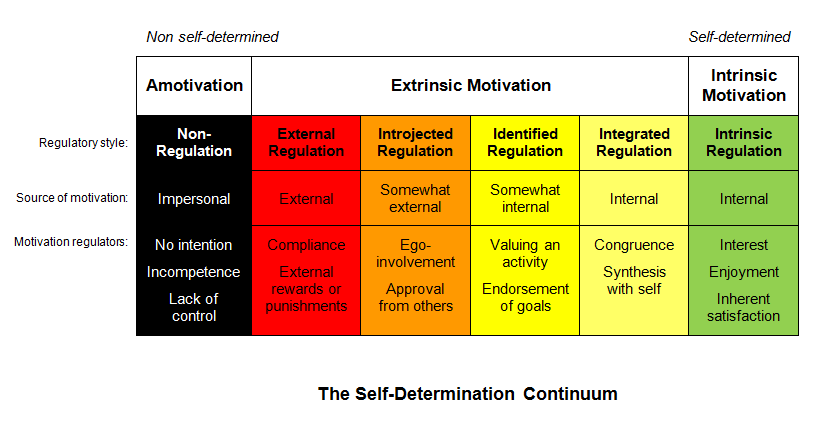
There are two bases for autonomous regulation: intrinsic motivation and well-internalized extrinsic motivation. In contrast to autonomous regulation, controlled regulation pertains to feeling pressured to perform a behavior (Deci and Ryan 2000) or pursue a goal (Sheldon 2002). Autonomous regulation occurs by intrinsic (i.e., ‘‘because of the fun and enjoyment which the goal will provide’’) and identified reasons (i.e., ‘‘because you really believe that it is an important goal to have’’). On the other hand, controlling regulation occurs because of introjected (i.e., ‘‘because you would feel ashamed, guilty, or anxious if you didn’t’’) or external reasons (i.e., ‘‘because somebody else wants you to’’). These qualities are illustrated in the diagram below:

Image result for self-determination continuum

Through this distinction, we can essentially expand intrinsic and extrinsic causes of motivation to incorporate the new clarifications found through autonomous and controlling regulation.


All in all, autonomous and controlling goals are another facet of achievement goal theory used to understand the motives behind a goal or behavior. Its inclusion is a necessary component for self-determination theory which provides a broad framework to analyze behavior and inform behavior change in many contexts of social psychology such as education, health care, work organization, and parenting.


Thursday, February 23, 2017

What are Achievement Goals?


Methods of motivation and goals play a significant part in academic development. Research suggests that only 25% of the variability in children’s achievement outcomes can be accounted for by their scores on tests of intelligence (Neisser et al., 1996). “A likely source of some of the additional variability is the specific achievement-related beliefs that children bring to the learning context: How talented am I in science? Am I am poor reader because I’m not trying hard enough, or am I just not very smart? How well do I want to perform in math and how hard will I strive to meet this standard? Indeed, considerable empirical evidence exists to support the claim that children’s beliefs about their intellectual competencies and views about the importance of school success have a powerful impact on academic behaviors and outcomes” (Eccles, Wigfield, & Schiefele, 1998).  

 Achievement goals are competence-based aims that individuals create as means to take action they are motivated to pursue.  Individuals typically have motives for their actions, so we can thus analyze goals from an orientation point of view. An important distinction in achievement goal literature is the difference between performance and mastery goals. We can differentiate between people's reasons for doing well as either ego or task related. Specifically, task (mastery) goals reflect perceived competence in terms of task mastery or evaluative standards. In this approach, individuals are learning for its own sake. Meanwhile, Ego-related (performance) goals reflect performance relative to the performance of others. A performance goal orientation is characterized by questions such as "Can I do better than others?" or "Will I look smart?"

On the other hand, a student with a learning goal orientation would more likely ask questions like "Can I improve my knowledge on this subject?" or "How can I do this task?"Studies within the achievement goal theory show that the pursuit of mastery goals was associated with various positive outcomes, including intrinsic motivation, self-regulated learning, and deep-level learning, whereas performance goals were found to be positively related to surface processing but unrelated or negatively to deep-level processing or self-regulated learning.

 Performance goals were found to predict academic performance in some research, but other studies failed to confirm these findings. As a result of conflicting data, further divisions in goals were created to include the idea of mastery approach goals (MAp), mastery avoidance goals (MAv), performance approach goals (PAp), and performance avoidance (PAv) goals. The rationale was that competence can be valued as a positive outcome to be achieved or incompetence can be valued as a negative outcome to be avoided.

 PAp goals are believed to yield positive effects, especially on achievement, because the external focus that characterizes these goals leads people to select strategic study strategies that yield high achievement. In contrast, PAv goals hinder learning and achievement, because the concern for failure is likely to disrupt the learning process, undermine the pleasure of learning and achievement, and result in low performance. Mastery goals appear to be primarily predictive of achievement that reflects deep learning.

This chart below provides a basic representation of the distinctions:


Achievement goal theory continues with autonomous and controlling goals and further subsets of goals. This desired to look at goals from "why" rather than the "what". 

Since its development, significant contributions have been made to the research and practice in education and psychology. Achievement goal theory has provided an influential framework for conceptualizing student motivation. Though complex, analyzing goals and people's intentions for their actions can allow for greater insight into motivation, learning, and achievement.